Overview
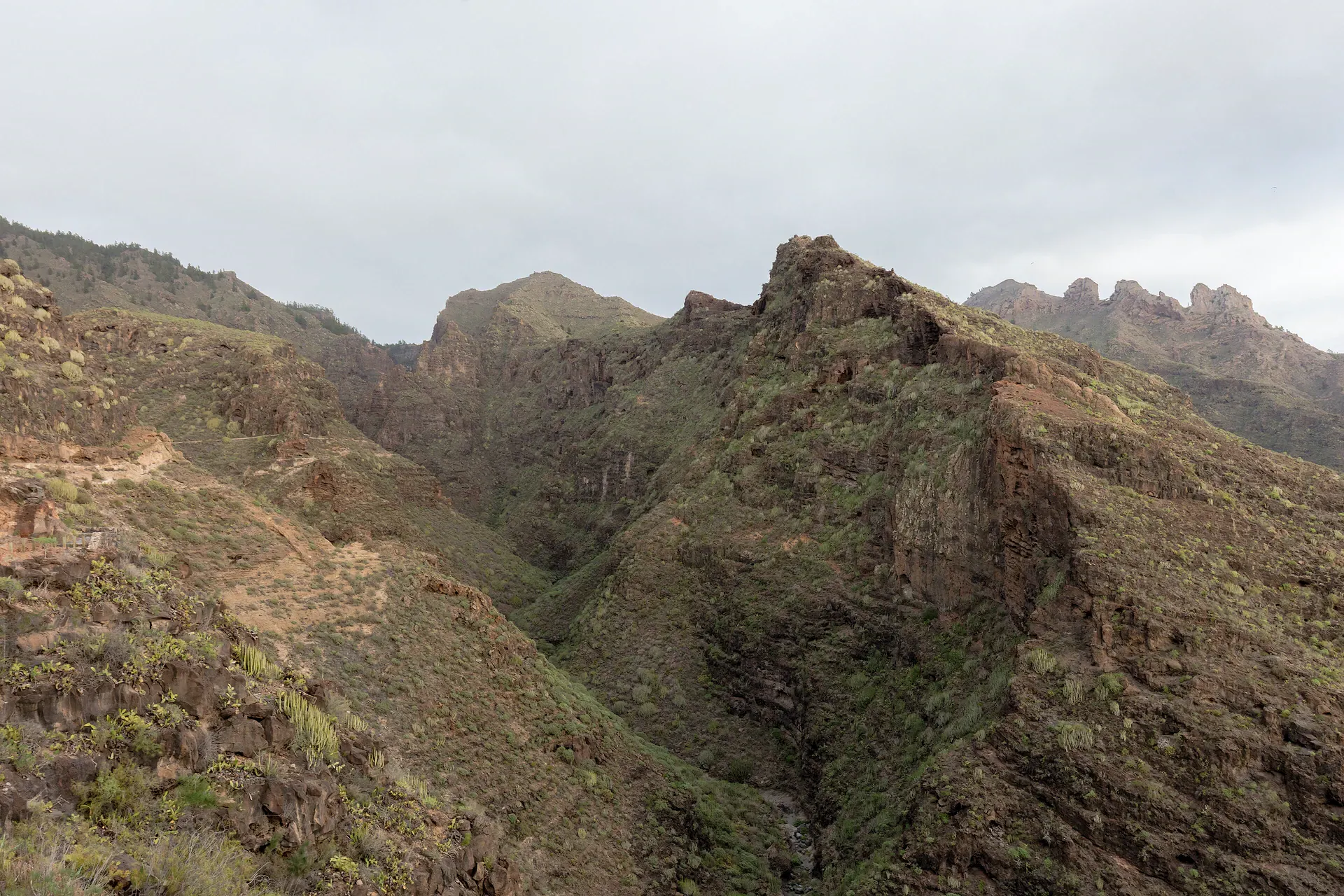
Barranco del Infierno (Hell’s Ravine) is a 6.5 km out-and-back walk up a protected gorge above Adeje, in the southwest. It takes about 3 hours, climbs roughly 250 m from about 350 m to about 600 m, and ends at a waterfall of around 200 m. Difficulty is rated medium-low.
You cannot walk in. Entry is by advance online booking only, at €16 for non-resident adults, with a morning entry window. You wear closed shoes and a loaned helmet throughout.
The trailhead is a short drive or bus ride inland from the resorts, so it is an easy half-day, finished before the afternoon. For tougher or permit-free walks, see the hiking hub or Masca Gorge.
Tickets and entry times
Tickets are sold only on the official Barranco del Infierno site. Nothing is sold at the gate.
| Visitor |
Price |
| Non-resident adult |
€16 |
| Non-resident child, 5 to 12 |
€8 |
| Canary Islands resident adult |
€6, with proof of residency |
Children under 5 are not admitted, and under-16s must go with an adult. Visitors enter in small groups spaced about 30 minutes apart, and the reserve is capped at 300 people a day. From November to April and in European school holidays, slots fill days or weeks ahead.
Entry is in the morning only, and the gorge is cleared early in the afternoon:
| Season |
Dates |
Entry |
Reserve closes |
| Winter |
16 September to 31 May |
08:30 to 11:30 |
14:30 |
| Summer |
1 June to 15 September |
08:00 to 10:30 |
13:30 |
Be at the reception at the top of Calle de los Molinos 15 minutes before your slot, with your confirmation and photo ID. Take one of the earliest slots if you can. The first half of the path is in direct sun, and an early start gets the climb done before midday.
Route, time and difficulty
The trail starts at the top of Calle de los Molinos in Adeje and climbs steadily along one path to the waterfall, then returns the same way. Cabildo mapping logs about 3 km each way with short dips that add up to roughly 520 m of cumulative elevation change. Allow 3 to 3.5 hours with a 15 to 20 minute stop at the waterfall.
The first half crosses the dry upper side of the ravine, with views back over Adeje to the Atlantic. The footing is stony, uneven and narrow in places, with drops beside wooden railings. People with vertigo may find these early ledges tense. The slopes carry dry southern scrub such as cardón and tabaiba.
After the midpoint the walls close in and the air cools. The path drops toward the shaded gorge bed, crosses damp stones and small bridges, and passes willows and other plants that live off permanent moisture. Caves once used by the Guanche people sit high on the cliffs, and kestrels, buzzards and ravens circle above. The last stretch is narrow, with slick stone and short steps up to the viewpoint below the falls. Then you walk back the same way.
There are no taps, bins or toilets past reception, so go before you start.
Waterfall by season
Springs feed the waterfall, so unlike most southern gorges it carries some water for most of the year. Flow still varies a lot.
From October to May, after the rains, you get a clear ribbon of water and cool mist, though even then it is a veil down the rock rather than a torrent. From June to September evaporation cuts it back, and by late summer it can be a thin trickle on the wall. The shaded gorge and the birds still make the walk worthwhile then, as long as you go for the canyon and not the spray.
Swimming or wading in the pool or any stream is forbidden, since the area is a Special Nature Reserve.
What to bring
Staff check every hiker at reception before handing out helmets, and open shoes end the hike there.
- Closed shoes or boots with good grip. Flip-flops, beach sandals and hiking sandals are not allowed.
- The helmet is loaned at the meeting point and must stay on for the whole walk because of rockfall risk.
- Water: 1 to 1.5 litres per person is the guideline, and 2 litres is better in warm months.
- Photo ID and your booking confirmation, plus residency proof if you booked the €6 rate.
- Sun hat, sunglasses and sunscreen. The outer half has little shade, while the inner gorge is cooler and damper, so light layers help.
- A bag for your rubbish.
The reserve bans animals, smoking, fires, camping, picking plants and glass. Stay on the marked path.
Closures and best time
The gorge closes in heavy rain, strong wind, rockfall risk or extreme heat. Check the live open or closed status on the official site on the morning, and wind and rain warnings on AEMET the evening before, especially from November to March. If your booking is cancelled, the operator offers a new date or refund, and the General Conditions on its site give the details.
South-coast daytime highs are about 20 to 22°C in winter and 25 to 26°C and up from July to September, and the unshaded walls trap heat around noon.
- November to March: coolest air and the best waterfall, with the main risk of rain or wind closures.
- April and May: steady sun, green inner gorge and comfortable mornings.
- June to September: hot and dry on the outer rim, and a thin waterfall. Take the 08:00 slot.
- October: cool mornings and low rain risk, but the waterfall stays light until the autumn rains.
Getting to Adeje
The entrance is at the top of Calle de los Molinos in the old town of Adeje, inland and uphill from Costa Adeje and Playa de las Américas. Afterwards, Playa del Duque in Costa Adeje and Playa de Las Vistas are the nearest swims.
By car there is no parking at the entrance. Park near Casa Fuerte de Adeje in the old town and walk 8 to 10 minutes uphill. Spaces fill quickly on hiking mornings, so arrive 30 minutes before your slot. From Tenerife South Airport it is about 22 to 25 km on the TF-1 and takes 20 to 25 minutes, or 10 to 15 minutes uphill from Costa Adeje hotels.
By bus, TITSA lines 417, 447 and 473 link Costa Adeje, and the latter two Los Cristianos, to Adeje town. Get off at Adeje El Cerco or the central stop and walk about 10 minutes up Calle de los Molinos. Line 460 comes from Icod and Guía de Isora via Costa Adeje, and airport line 40 reaches Costa Adeje station, where you change. Check morning timetables the night before so you do not cut the 15-minute check-in close.
After the hike
You come out of the gorge around lunchtime, in the old town. Adeje is known for pollo al ajillo, fried garlic chicken with mojo sauces and papas arrugadas. Restaurante Otelo is on Calle de los Molinos, close to the entrance, and Restaurante Oasis is on Calle Grande. Check opening days before you go, as Otelo closes one day a week.
The old town is also worth an hour. Plaza de España and the church of Santa Úrsula are within a short walk of the trailhead, and the ruins of Casa Fuerte are beside the hiker car park.
Who it suits
It works best for people staying on the southwest coast who want a half-day canyon walk without driving across the island or sorting out Masca’s bus and boat logistics. Families with children aged 5 and up can do it if the children wear closed shoes and keep helmets on, and the distance of 6.5 km with about 250 m of net climb is manageable.
Skip it, or pick another walk, in these cases:
- You get vertigo. The early ledges are narrow, with drops beside the railings, and flatter caldera walks such as Roques de García suit better.
- You want to swim. Bathing in the pool or stream is banned, and in summer the waterfall can shrink to a trickle.
- You cannot book ahead. There are no walk-up tickets, so a permit-free route such as Roque del Conde is the fallback.
- You have a child under 5, who is not admitted.
A simple plan is to book the earliest winter or summer slot, park near Casa Fuerte (or take the bus), be at reception 15 minutes early, walk up at an easy pace, rest at the falls, and be back by late morning with lunch in the old town.