
The story
Short answer
The best way to get around Tenerife depends on what you plan to do. A hire car is the most flexible choice for Teide, Masca, Anaga and the north coast. Buses and the tram work well for a resort-based trip with a few day trips along the main roads. Taxis cover short hops and airport runs, and organised tours remove the driving from the mountain days.
How to get around Tenerife by trip type:
| Trip | Best option | Why |
|---|---|---|
| Beach holiday in one resort | Buses and walking, taxi for evenings | Resorts are compact and the south coast road is served by many TITSA lines |
| Resort plus Teide, Masca, Anaga | Hire car for 2-4 days | Mountain and rural roads have few or no regular buses |
| Santa Cruz and La Laguna | Tram and bus | The tram links the two in about 30 minutes |
| Airport to hotel | Bus or taxi | Both airports have ranks and TITSA stops |
| One big mountain day, no driving | Organised tour | Hotel pickup and no parking or hairpin stress |
For flights and arrival see Getting to Tenerife: Flights, Airports and Ferries. To choose a base so you drive less, read Where to Stay in Tenerife: Best Areas by Trip Type.
Distances between main areas
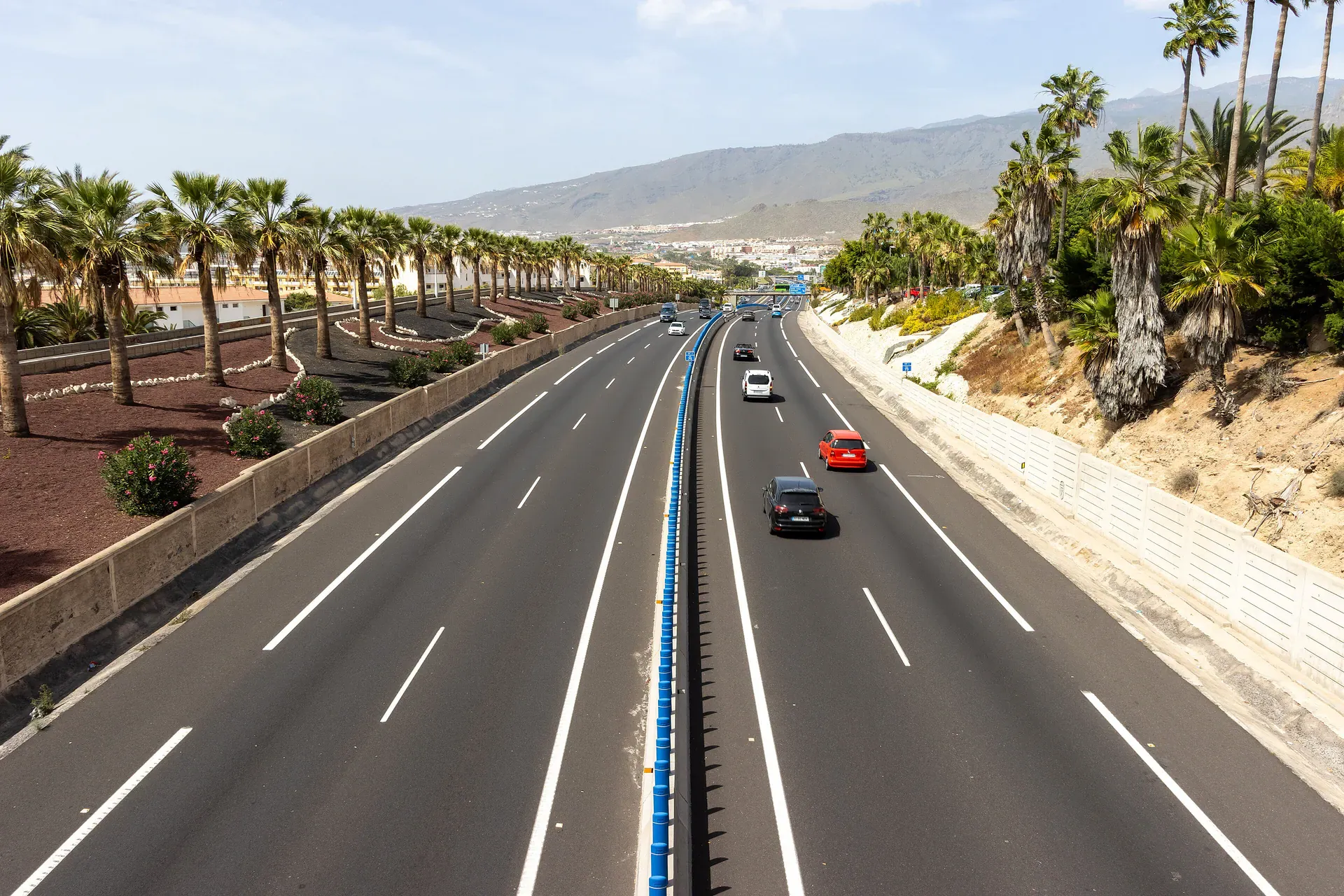
How long it takes to drive around Tenerife is mostly a question of which road you are on. The TF-1 motorway along the south and east coast and the TF-5 on the north coast are fast. Mountain roads to Teide, Masca and Anaga cover far fewer kilometres per hour, so the distances below are a floor, not a timetable.
Official road distances from the Tenerife tourist board (Turismo de Tenerife distance table), in km:
| From | Santa Cruz | Puerto de la Cruz | Los Cristianos | Los Gigantes |
|---|---|---|---|---|
| Santa Cruz | - | 41 | 77 | 93 |
| Puerto de la Cruz | 41 | - | 81 | 53 |
| Los Cristianos | 77 | 81 | - | 40 |
| Playa de las Americas | 75 | 85 | 4 | 29 |
| Tenerife South airport | 66 | 111 | 27 | 55 |
| Tenerife North airport | 10 | 27 | 88 | 82 |
| Teide (park) | 102 | 84 | 63 | 43 |
Planning notes from those numbers:
- Playa de las Americas and Los Cristianos to Puerto de la Cruz is 81-85 km, a long day return. Pick one coast for your base and visit the other as a single outing.
- Teide is 63 km from Los Cristianos but the last stretch climbs through hairpins, so the real cost is the climb, not the distance. Details are in Mount Teide: Cable Car, Permits and the Best Ways to Visit.
- The two airports are 88 km from Los Cristianos (North) and 111 km from Puerto de la Cruz (South). A flight into the wrong airport adds a long transfer.
Speed limits help estimate the fast stretches: 120 km/h on motorways and 90 km/h on conventional roads, per the Spanish consumer portal on driving in Spain.
Buses and the tram
TITSA runs the green interurban buses (guaguas) across the island. Buses reach every region, including Teide, but frequency drops sharply outside the main corridors, so check the timetable of the exact line the day before.
Tickets and passes
Prices below are from the TITSA fares page:
- Single and return tickets: pay by bank card or cash on the bus.
- Ten+ card: 2 EUR for the card, then top up the Ten+ Wallet from 2 to 100 EUR for lower per-trip fares.
- Day Travelcard: 10 EUR, valid 24 hours from first use, unlimited buses and tram.
- 7 Days Travelcard: 50 EUR, unlimited buses and tram for 7 days.
- A same-day return ticket is 10% off the single price on trips of 20 km or more.
- The Ten+ Movil app sells the travelcards and single tickets.
Buy the Ten+ card at airport ticket machines, TITSA bus station offices, kiosks or tram ticket machines.
The tram
The tram connects Santa Cruz de Tenerife and La Laguna in about 30 minutes (Turismo de Tenerife). Line 1 is the main line, and Line 2 links La Cuesta and Tincer, with changes to Line 1 at El Cardonal or Hospital Universitario. The tram accepts the same travelcards as the bus.
Where buses stop being useful
Buses do not suit one-day trips that combine several remote spots, early sunrise starts, or hiking trailheads far from a village. Teide has a bus, but timing leaves little margin for the cable car and a return ride, so plan that day with the Teide guide above.
Taxis and transfers
Taxis are available for any destination on the island. They run on meters and are the practical choice for late evenings, airport arrivals with heavy bags and short hops between resorts.
Price checks that save money:
- Ask for a rough fare before leaving for long trips and compare it with the distance table above.
- For airport transfers, official taxi ranks sit outside both terminals.
- For a day of sightseeing with a driver, ask the taxi for a fixed price in advance rather than paying by the meter plus waiting time.
- For group arrivals at night, a pre-booked transfer often beats waiting at a rank.
Airport arrival options by bus and taxi are covered in Getting to Tenerife: Flights, Airports and Ferries.
Driving in Tenerife
Rules that matter to visitors
The Spanish consumer portal lists the basics:
- Speed limits for cars: 120 km/h on motorways and 90 km/h on conventional roads.
- Alcohol limit: 0.25 mg/l of breath (0.5 g/l of blood). Novice and professional drivers have a lower limit.
- Holding a mobile phone while driving is prohibited.
- Children must use a child restraint suited to their height and weight.
- On roads with more than one lane each way, change lanes fully to pass cyclists, keeping at least 1.5 m of separation.
- Municipalities with over 50,000 inhabitants have had low emission zones since 1 January 2023, so follow the signs in towns such as Santa Cruz.
- Carry your driving licence. Non-EU visitors are advised to carry an international licence alongside their own.
Mountain roads
The mountain roads are the real driving challenge. Roads to Teide, Masca and Anaga are narrow, wind through many bends and run through cloud in the north. Start early, leave space behind buses and use a low gear on long descents. For Teide, the road choices and parking are set out in the Teide guide linked above.
Parking and fuel
Parking in the old towns of La Laguna, La Orotava and Santa Cruz is the usual headache, so park outside the centre and walk. At Teide, the cable car base station car park has 220 spaces according to Volcano Teide, and fills on busy mornings. There are no petrol stations inside the national park, so fill up before climbing.
Hire car tips
A hire car is the best way to get around Tenerife for most itineraries that go beyond one resort. A few habits make it cheaper and easier:
- Book before you fly and compare the total with excess cover included.
- Pick up at the airport you land at. Collecting from a resort office saves a day’s rental if you do not need the car at the start.
- Choose a small car for mountain roads and old towns. An automatic is easier on steep hill starts.
- Check the excess and what the policy covers for tyres, glass and the underside.
- Photograph the car at pick-up and take the fuel level on record.
- Skip the car on days you stay at the beach and rent for the days you drive. Many visitors take a car for three or four days of a week.
The site also covers the Tenerife itinerary, which groups sights by area so you can place car days efficiently.
Without a car: what you can reach
Without a car, you can reach:
- Santa Cruz and La Laguna by bus and tram.
- Most south and north resorts by TITSA, from the coast roads.
- Teide on the dedicated bus, or on a guided tour with hotel pickup.
- Barranco del Infierno in Adeje, from the village.
- Masca on foot as a booked hike, since access to the gorge is by reservation.
You will find it hard to reach rural trailheads, the Anaga coast villages at off-peak times, and many viewpoints. For these, book a guided tour or share a taxi for the day. A mixed plan works: buses for the base, a car for two or three days. See Things to Do in Tenerife: What Is Worth Your Time, by Area and Season for which sights fit a car-free trip.
Accessibility and luggage
Buses are the green TITSA coaches, so luggage space is limited. For two large suitcases, taxis and transfers are easier. On the tram and buses, keep bags near you and use the front door on boarding with the Ten+ card.
If you travel with a wheelchair, children in a pushchair or heavy bags, a taxi or hire car is the most reliable choice. Ask the rental company for child seats at booking. Cobbled and steep old-town streets in La Laguna and Garachico are hard on wheels, so plan a car park near the entrance.
More guides
-
 Travel Guides
Flight Time to Tenerife
Flight time to Tenerife from London is about 4h20-4h35 nonstop.
-
 Travel Guides
Best Time to Visit Tenerife
Best time to visit Tenerife: May, June and September-October bring 24-28 C, warm seas and lower crowds
-
 Travel Guides
Itinerary Tenerife
Itinerary Tenerife: day-by-day plans for 3, 5 and 7 days, built around driving distances
-
 Travel Guides
Best Place to Stay in Tenerife
The best place to stay in Tenerife depends on your trip: Costa Adeje for beaches
-
 Travel Guides
Do You Need a Visa for Tenerife? Entry Rules and Passport Basics
Do you need a visa for Tenerife?