
The story
Overview
Visiting Tenerife Mount Teide comes down to one choice before you leave the coast: drive the free caldera roads around 2,100-2,350 m, ride the cable car to 3,555 m for 43 EUR return, or book a separate 15 EUR permit on Tenerife ON to climb the final steep trail to the 3,715 m crater. Teide National Park has no entrance gate or entry fee, so you can see the lava fields, Roques de García and roadside viewpoints with a rental car and zero advance tickets. Stepping onto the upper volcano requires timed online bookings, warm clothing even in August, and a backup day in case wind shuts the lift.
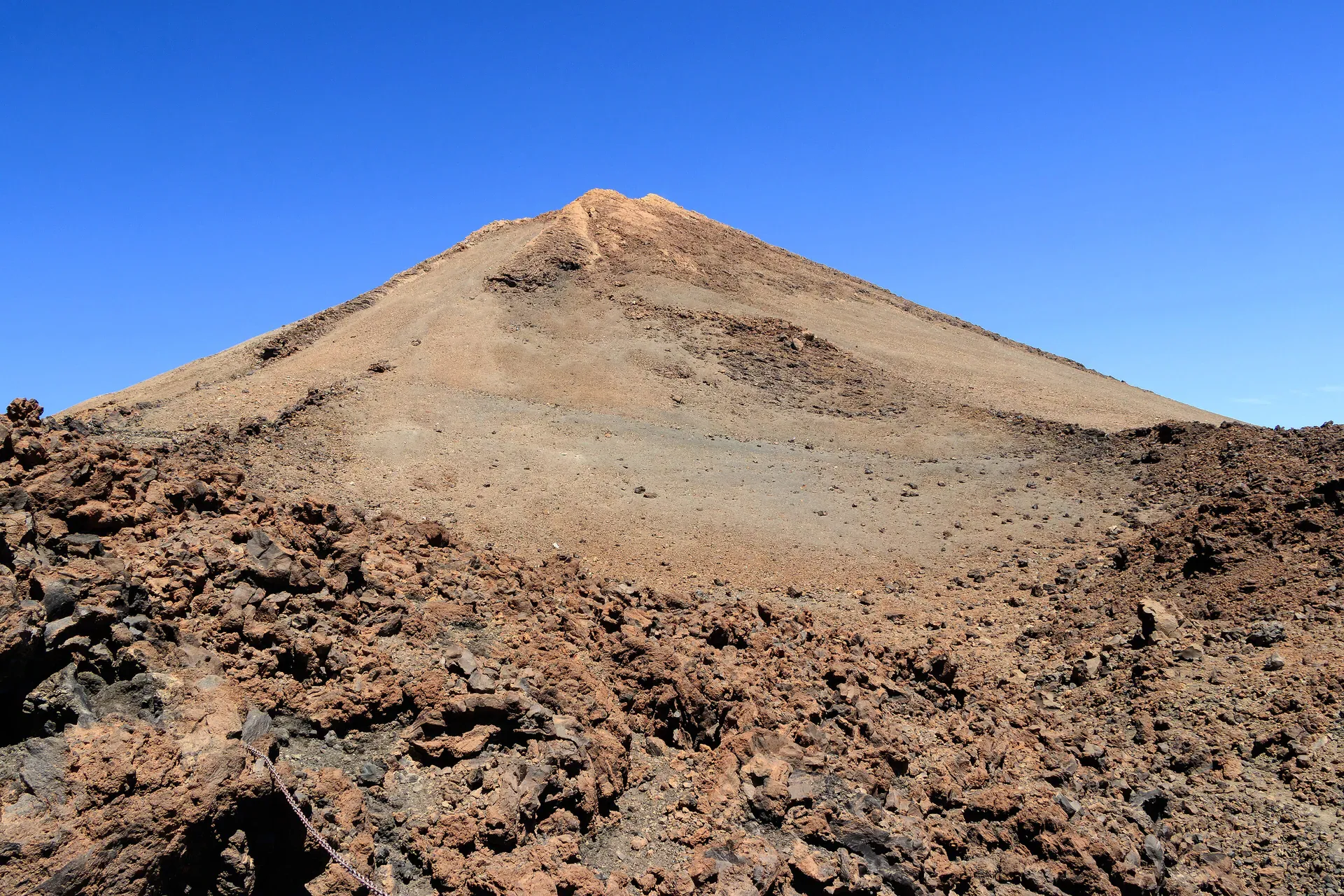
Mount Teide, Tenerife’s central stratovolcano, is Spain’s highest peak at 3,715 m above sea level, and Teide National Park is a UNESCO World Heritage Site.
Most failed trips happen for three avoidable reasons: assuming a cable car ticket includes summit crater access, arriving at the base station mid-morning with nowhere to park, or packing beachwear for cold air and ridge gusts. Cable car prices, hours, footwear rules and refuge details were checked in November 2026 against Volcano Teide and Refugio de Altavista. Recheck permits on Tenerife ON before booking.
How to visit Tenerife Mount Teide: your options compared
Pick your format based on how high you want to go, how far ahead you are booking, and whether everyone in your group can handle rapid altitude gain.
| Option | Max altitude | Direct cost (non-resident adult) | Advance booking needed | Best for | Main trade-off |
|---|---|---|---|---|---|
| Scenic drive and caldera walks | ~2,356 m (roadside) | Free (fuel/car hire only) | None | Families with toddlers, relaxed half-day, budget trips | Stays on the caldera floor; no upper-cone views |
| Teide Cable Car (return) | 3,555 m (La Rambleta) | From 43 EUR return (21.50 EUR child 3-13) | Days to weeks ahead online | Short visits, wide views over the island and Pico Viejo | Frequent wind closures; no crater peak |
| Cable car + PNT 10 summit permit | 3,715 m (Pico del Teide) | From 43 EUR + 15 EUR permit | Up to 56 days ahead (Mondays 07:00) | Standing on Spain’s highest point without a 5-6 h climb | Permit slots sell out fast; strict gear check |
| Foot ascent via Montaña Blanca (PNT 07) | 3,536 m (or 3,715 m with PNT 10 / refuge) | 6 EUR weekday / 10 EUR weekend (+ 15 EUR PNT 10, or 71 EUR Altavista Refuge) | Weeks ahead on Tenerife ON or refuge portal | Experienced mountain hikers, sunrise summit attempts | 8.29 km and ~1,309 m gain up; harsh wind and cold |
| Guided Mount Teide tour | 2,356 m to 3,715 m | From 52 EUR (without cable car) to 178 EUR (summit + cable car) | Days to weeks ahead | No rental car, sold-out DIY summit permits, stargazing | Fixed group pace; higher cost per person |
A scenic drive works better than many visitors expect. Driving the TF-38 or TF-21 puts you inside a volcanic basin above 2,000 m surrounded by lava fields and the rock formations of Roques de García, where the free PNT 03 loop runs 3.5 km (about 1 hour 55 minutes) with no permit needed. Strong walkers who want high volcanic scenery without fighting for PNT 10 slots can also look at Pico Viejo Trail: A Quiet One-Way Walk to Narices del Teide, which crosses the western lava fields without touching the summit checkpoint.
If your goal is reaching the 3,715 m crater itself, check Tenerife ON before booking your cable car. When public PNT 10 slots are gone for your dates, two legal paths remain: reserve a bunk at Refugio de Altavista (which automatically bundles a next-morning sunrise summit permit) or book an official guided summit ascent that holds its own guide quota.
Teide Cable Car tickets, queues and last ascent
The Volcano Teide cable car climbs from the base station at 2,356 m beside the TF-21 to La Rambleta at 3,555 m in under 8 minutes. Cabins hold up to 44 passengers, though the operator usually boards 35. Buying online ahead of time is the standard way to ride; walk-up availability disappears quickly on clear mornings.
Ticket prices (checked November 2026)
| Ticket type | Non-resident adult | Non-resident child (3-13) | Canary Islands resident adult | Canary Islands resident child |
|---|---|---|---|---|
| Return | From 43 EUR | From 21.50 EUR | 10.75 EUR | 5.38 EUR |
| One-way | 24 EUR | 12 EUR | 6 EUR | 3 EUR |
Children under 3 are not permitted on board, and children under 16 must be accompanied by an adult. Return tickets reserve only the ascent: you join the descent queue and go down in order of arrival. Walkers who climb up Montaña Blanca can buy a descent-only ticket at the upper station by QR code for 23 EUR while the lift is running.
Hours, boarding queues and the 1-hour rule
Daytime service starts at 09:00. In 2026 the last ascent is 16:00 and the last descent 16:50 from 1 January to 27 March, 13 April to 30 June and 25 October to 31 December. From 28 March to 12 April and 1 July to 30 September the last ascent is 17:40 and the last descent 18:30. In October the times are 17:00 and 17:50 (1 to 13 October) and 16:30 and 17:20 (14 to 24 October). A separate sunset service runs outside these hours. Check the live calendar for your exact date before driving up.
Be at the base station 20 minutes before the slot on your ticket, because arriving late forfeits the right to board. The upper-station stay is limited to one hour, extended to two hours if you hold a crater access permit and the trail is open. Two free short trails start at the upper station:
- PNT 11 (Mirador de la Fortaleza): roughly 0.61 km linear, about 25 minutes, looking northeast over northern Tenerife and the sea of clouds below.
- PNT 12 (Mirador de Pico Viejo): roughly 0.7-0.8 km round trip, 30-60 minutes depending on pace in thin air, looking into the multicoloured crater of Pico Viejo.
Neither PNT 11 nor PNT 12 requires the PNT 10 summit permit.
Wind closures and refunds
High winds and ice close the cable car frequently and at short notice, especially from November through March. Check live lift status on the morning of your visit before leaving your hotel. If the lift cannot run, Volcano Teide notifies you by email or text at about 08:30. Changes and cancellations are free until 18:00 the day before; after that changes are refused and cancellations are charged in full. You can move a booking up to 3 times within a year, and a full refund applies for unused tickets if wind or a technical fault delays boarding by 90 minutes or more. Put Mount Teide early in your Tenerife stay so you have spare days if wind wipes out your first attempt.
Summit permits on Tenerife ON and how to book
Reaching the 3,715 m rim of Pico del Teide requires walking Trail PNT 10 (Telesforo Bravo), a steep volcanic path of roughly 650-700 m one way from La Rambleta with gradients reaching 60%. Most walkers take 30 to 45 minutes up and the same back down, moving slowly in the thin air.
PNT 10 Telesforo Bravo rules and fees
Access to PNT 10 is managed exclusively online through Tenerife ON, the Cabildo de Tenerife’s official trail platform. You must register a personal account before booking.
- Release schedule: new permits open every Monday at 07:00 Canary Islands time for the following 56 days.
- Time slots: permits are issued for fixed daytime entry windows, roughly 09:00-17:00.
- Fees (checked November 2026): 15 EUR for non-residents, 6 EUR for residents of other Canary Islands, and free for Tenerife residents and children under 14.
- Validity: bookings are tied to your named ID. Check the change and refund terms when you book.
A cable car ticket does not include a PNT 10 permit, and a PNT 10 permit does not include a cable car ticket. Book the permit first on a Monday morning, then buy a cable car slot that leaves buffer before your PNT 10 window starts for boarding queues and the ride.
Hiking up via PNT 07 Montaña Blanca
If you prefer to skip the ascent cabin and walk the active volcano Tenerife hikers treat as a major endurance climb, Trail PNT 07 (Montaña Blanca to La Rambleta) starts off the TF-21 at 2,348 m and finishes at 3,536 m. It covers 8.29 km one way with roughly 1,309 m of ascent and 122 m of descent, taking 5 to 6 hours up.
PNT 07 also requires an advance reservation on Tenerife ON. Non-residents pay 6 EUR on weekdays and 10 EUR on weekends and public holidays (other Canary Islands residents pay 3 EUR / 5 EUR; Tenerife residents go free). Booking PNT 07 gets you to La Rambleta only; it does not open the gate onto PNT 10 unless you hold a separate PNT 10 permit or an Altavista Refuge overnight booking.
Warden checkpoints and what to do if permits sell out
Park wardens can deny access to anyone without the mandatory equipment (see the kit list below). Carry original ID matching the permit name.
When DIY PNT 10 slots are sold out for your trip dates, you have two legal alternatives:
- Stay overnight at Refugio de Altavista (3,260 m), which includes Montaña Blanca (PNT 07) permits and a next-morning PNT 10 permit.
- Book a guided Mount Teide tour sold by the cable car operator. Volcano Teide’s Climbing the Teide Crater + Cable Car package starts from 178 EUR per person.
Altitude, weather exposure and who should skip the ascent
The cable car lifts you 1,199 vertical metres, from 2,356 m to 3,555 m, with no time to acclimatise. Even fit walkers notice heavier breathing on the short path to Mirador de Pico Viejo, and dizziness or nausea can hit above 3,500 m.
Volcano Teide enforces strict health and safety bans on boarding the cable car:
- Children under 3 years old are prohibited.
- Pregnant women are prohibited.
- People with cardiovascular conditions are prohibited.
- People with altitude sickness symptoms, nausea, fever, pain or illness are prohibited.
- Children under 16 must be accompanied by an adult.
- People with physical or motor disabilities are not permitted on the cable car.
Anyone feeling dizzy, short of breath or unwell at the base station should stay on the caldera floor.
Even at caldera level, exposure catches beachgoers off guard. Winter nights drop near freezing, and above 3,500 m air temperatures drop further and ridge winds cut through light jackets quickly. High-factor sunscreen, sunglasses and water matter as much as a fleece.
Driving routes, parking and TITSA buses
Renting a car gives you the freedom to arrive before tour coaches, stop at viewpoints and time the light. For island-wide car hire, fuel and bus basics, see Getting Around Tenerife: Car, Bus, Taxi and Tours.
Three main mountain roads
All three paved approaches climb steeply through pine forest before breaking above the clouds into the caldera. There are no petrol stations anywhere inside Teide National Park, so refuel on the coast or in the lower towns before climbing. An automatic gearbox makes steep restarts behind tour buses much less tiring.
| Road | Connects from | Road character |
|---|---|---|
| TF-38 (Chío road) | Costa Adeje, Los Gigantes, southwest | Widest lanes, gentlest gradients, fewest tight hairpins; easiest drive for nervous mountain drivers |
| TF-21 (North) | Puerto de la Cruz, La Orotava | Closest major resort approach; steep winding climb through Aguamansa pine forest to El Portillo |
| TF-21 (South) | Los Cristianos, Costa Adeje via Vilaflor | Scenic through Vilaflor with frequent hairpin bends and slow uphill traffic |
| TF-24 (La Esperanza ridge) | Santa Cruz, San Cristóbal de La Laguna | High forest ridge through eucalyptus and pine forest to Mirador de la Tarta |
Parking reality inside the park
Every car park inside Teide National Park is free, and the popular ones run out of spaces early. The Cable Car base station lot on the TF-21 has 220 spaces and can fill up by mid-morning, and vehicles cannot enter or leave outside operating hours. Aim to pull in before 09:00 for a morning slot, or book an afternoon ride as morning visitors leave.
The Montaña Blanca trailhead for PNT 07 relies on small gravel pull-offs and roadside shoulders along the TF-21. Because summit hikers leave their cars for many hours, those bays fill early in the morning. Other free parking areas sit beside the Parador de Las Cañadas del Teide (for Roques de García and Cañada Blanca Visitor Centre) and at El Portillo Visitor Centre near the northern entrance.
Public buses: TITSA Lines 342 and 348
You can reach Tenerife Teide by public bus, though the service is sparse and leaves little margin for hiking. TITSA line 342 serves the park from the south (Costa Adeje and Los Cristianos via Vilaflor) and line 348 from the north (Puerto de la Cruz and La Orotava). Line 342 takes about 2 h 15 min each way and runs daily: morning departures at 09:25 and 09:40, afternoon returns at 15:15, 15:40 and 16:00. Line 348 takes about 1 h 40 min and runs daily: morning departures at 09:30 and 09:45, afternoon returns at 16:00, 16:05 and 16:30. With one return bus mid-afternoon, plan your cable car slot and walks around it. Check titsa.com for fares and which passes are valid.
Best season, time of day, snow and closures
Mount Teide sits in a subalpine climate zone that behaves nothing like Tenerife’s coastal beaches. Winter and spring bring frost and snow at caldera altitude, while summer is dry and sunny:
| Season | Frost and snow pattern | Visiting notes |
|---|---|---|
| Winter (Dec-Feb) | Frost most nights; snow possible | Highest risk of cable car wind closures and icy road closures; crampon and ice axe rules on upper trails |
| Spring (Mar-May) | Frost eases by May | Clear skies; red tajinaste (Echium wildpretii) blooms in May and early June |
| Summer (Jun-Aug) | No frost | Longest cable car hours; intense sun and dry air |
| Autumn (Sep-Nov) | Frost returns by November | Mild daytime air through October with lighter crowds than summer |
Spring (late April through June) and early autumn (September and October) balance mild daytime walking temperatures, reliable cable car operations and manageable crowds. May and early June add the red tajinaste bloom around El Portillo and inside the El Portillo Visitor Centre native botanical garden. For how mountain conditions compare with beach weather around the island, see Best Time to Visit Tenerife: Month by Month for Sun, Sea and Hiking.
During winter storms, snow and black ice trigger immediate closures on the TF-21, TF-24 and TF-38 by the Cabildo de Tenerife road service. Check three official feeds before driving up in winter: the Cabildo Road Information Centre (cic.tenerife.es) for roads, Tenerife ON for trail closures or crampon mandates, and Volcano Teide for live cable car status.
For free roadside sights, there are visitor centres at El Portillo (TF-21 north entrance) and Cañada Blanca (beside the Parador); check opening hours before you go. Arrive before 09:00 for emptier car parks and clear morning light.
Stargazing, Teide Observatory and sunrise options
Teide National Park sits above 2,000 m, often clear of the coastal cloud layer. You can drive up independently at dusk to roadside pull-offs near Roques de García or along the caldera floor with a warm coat and a torch, keeping in mind that temperatures drop sharply after sunset.
Guided sunset, stargazing and observatory tours
For a guided evening, Volcano Teide runs two main programmes:
- Sunset & Stars (from 159 EUR, about 8 hours): an evening programme with a sunset cable car ascent and stargazing.
- Cable Car at Sunset (from 72 EUR, about 2 hours): a shorter sunset ride on the separate evening service.
Staying inside the park: Parador and Refugio de Altavista
Two overnight options put you inside the national park after dark, built for very different travellers:
- Parador de Las Cañadas del Teide (~2,152 m): the only hotel inside the national park, directly opposite Roques de García. Staying here lets you walk out under the stars and catch first light on the caldera without a midnight mountain drive.
- Refugio de Altavista (3,260 m): renovated in 2026, with 49 beds in three shared dormitories. No bedding is provided, so bring a sleeping bag. There are no showers and the maximum stay is one night. Check-in opens at 19:00 and must be completed before 22:00. Rates are 71 EUR standard, 56.80 EUR for FEDME members and from 29 EUR for Tenerife residents. A booking includes Montaña Blanca (PNT 07) permits and a next-morning PNT 10 permit (06:00-09:00, leave the trail by 09:00), making it a legal way to watch sunrise from the 3,715 m summit.
What to wear and pack for Teide
Dressing for sea-level beach weather is the quickest way to cut a Teide visit short or get turned away at a checkpoint.
For the cable car and viewpoints
- Closed-toe hiking or sports shoes with high-grip, non-slip soles (compulsory on the cable car; sandals, heels, wedges and flat beach shoes are refused).
- Long trousers and a warm fleece or windproof jacket, even in July and August.
- High-SPF sunscreen, UV sunglasses, lip balm and plenty of water.
- Original photo ID or passport if you also hold a PNT 10 summit permit.
Mandatory warden-checked kit for PNT 07 and PNT 10 hikers
Park staff can deny access on Montaña Blanca (PNT 07) and Telesforo Bravo (PNT 10) to anyone missing required equipment:
- Mountain footwear: high-top hiking boots or closed trekking shoes with grippy soles (smooth soles and open shoes are barred).
- Clothing: long trousers even in summer, warm weatherproof layers and a thermal blanket.
- Water and food: at least 1.5 litres of water per person and energy food.
- Safety gear: a fully charged phone and a torch or head torch with spare batteries.
- ID: passport, DNI or NIE, plus your booking confirmation.
- Snow or ice conditions: when trails close for snow or ice, access is limited to expert mountaineers with 10 or 12 point crampons, an ice axe, winter clothing and a signed declaration of responsibility.
More guides
-
 Travel Guides
Things to Do in Tenerife
Things to do in Tenerife by area: Mount Teide cable car and permits, Anaga and Masca hikes, whale watching
-
 Travel Guides
Best Time to Visit Tenerife
Best time to visit Tenerife: May, June and September-October bring 24-28 C, warm seas and lower crowds
-
 Travel Guides
Itinerary Tenerife
Itinerary Tenerife: day-by-day plans for 3, 5 and 7 days, built around driving distances
-
 Travel Guides
Best Place to Stay in Tenerife
The best place to stay in Tenerife depends on your trip: Costa Adeje for beaches
-
 Travel Guides
Flight Time to Tenerife
Flight time to Tenerife from London is about 4h20-4h35 nonstop.