Overview
The summit of Teide (3,715 m) is reachable two ways. You can walk 9.0 km and climb 1,492 m from Montaña Blanca on trails PNT 07 and PNT 10, which takes 5.5 to 6.5 hours up. Or you can ride the cable car to La Rambleta (3,555 m) in about 8 minutes and walk the last 0.7 km on PNT 10, Telesforo Bravo, in 40 to 45 minutes.
Both routes need a summit permit booked in advance on Tenerife ON, the Cabildo’s booking site. The cable car ticket does not include one. Without the permit you stop at La Rambleta, where two short viewpoint trails need no permit.
For most visitors the cable car plus PNT 10 is the sensible choice. The full climb is a hard day on loose scree at altitude, and it only makes sense if you are fit and start early. For permit-free walks in the same park, see Alto de Guajara and Roques de García. Other routes are in the hiking hub.
Climb or cable car
| Option |
Distance |
Ascent |
Time |
Permit and lift cost (non-resident) |
| Cable car return + PNT 10 |
0.7 km each way |
183 m |
2 to 2.5 hours at the top |
€57 (€42 lift + €15 permit) |
| Montaña Blanca up, cable car down |
9.0 km up |
1,492 m |
5.5 to 6.5 hours up |
€45 to 49 (€6-10 + €15 + €24 one-way lift) |
| Montaña Blanca up and down on foot |
18 km return |
1,492 m |
9 to 10.5 hours |
€21 to 25 (€6-10 + €15) |
| Altavista Refuge overnight |
9.0 km, split over 2 days |
1,492 m |
about 4.5 hours, then about 2 |
From €71 (bed includes both permits) |
Hiking up and riding down saves your knees, since the steep scree below the refuge is the hardest part of the descent on foot. The catch is the car: you start at Montaña Blanca (km 40.2 of the TF-21) and finish at the cable car base, so you need a lift or a bus back to your vehicle.
Summit permits
Permits are booked on the Cabildo’s Tenerife ON site and app. You cannot buy one at the cable car or at the trailhead.
The fees for the two main ascent trails, in force since January 2026:
| Trail |
Visitors from outside the Canaries |
Other Canary residents |
Tenerife residents, children under 14 |
| PNT 10 Telesforo Bravo (summit) |
€15 |
€6 |
Free |
| PNT 07 Montaña Blanca, Monday to Friday |
€6 |
€3 |
Free |
| PNT 07 Montaña Blanca, weekends and holidays |
€10 |
€5 |
Free |
PNT 09, PNT 23 and PNT 28 on the upper slopes are also regulated and need a free reservation. Walking a regulated trail without a permit can bring a fine of up to €600.
How booking works:
- Create your Tenerife ON account before release day, so you are not entering passport details while slots go.
- New slots are released every Monday at 07:00 Canary time, up to 56 days ahead. Winter, Easter and autumn dates go fast.
- Permits are nominal. Rangers compare the reservation with your passport or national ID.
- Cancel at least 3 days ahead if plans change. A no-show blocks your account from booking for 3 months.
- Book the permit first, then a cable car slot that leaves you enough time to reach the PNT 10 gate before your slot opens. Plan for 45 to 60 minutes of margin, because lift queues are real.
If PNT 10 is sold out, accredited guiding companies hold separate allocations. They cost more than booking yourself, but they are the other legal route to the summit.
Montaña Blanca route
The route starts at km 40.2 of the TF-21 (about 2,348 m), follows PNT 07 for 8.3 km and 1,309 m to La Rambleta, then PNT 10 for 0.7 km and 183 m to the summit. The official grade is hard for both parts. There is no water on the way and no shade at all.
Park early, because the small car park fills in the morning. The first stretch is a wide pale pumice track with a gentle grade. About halfway along it you pass the Huevos del Teide, dark lava balls that rolled down the slope while molten.
Near the old mule station at about 2,700 m the track ends and the path steepens into switchbacks up Lomo Tieso, over loose scree and stepped basalt. Pace gets slower above 3,000 m, and short steady steps work better than pushing between rests. Most people reach Refugio de Altavista (3,260 m) 3.5 to 4.5 hours after leaving the road.
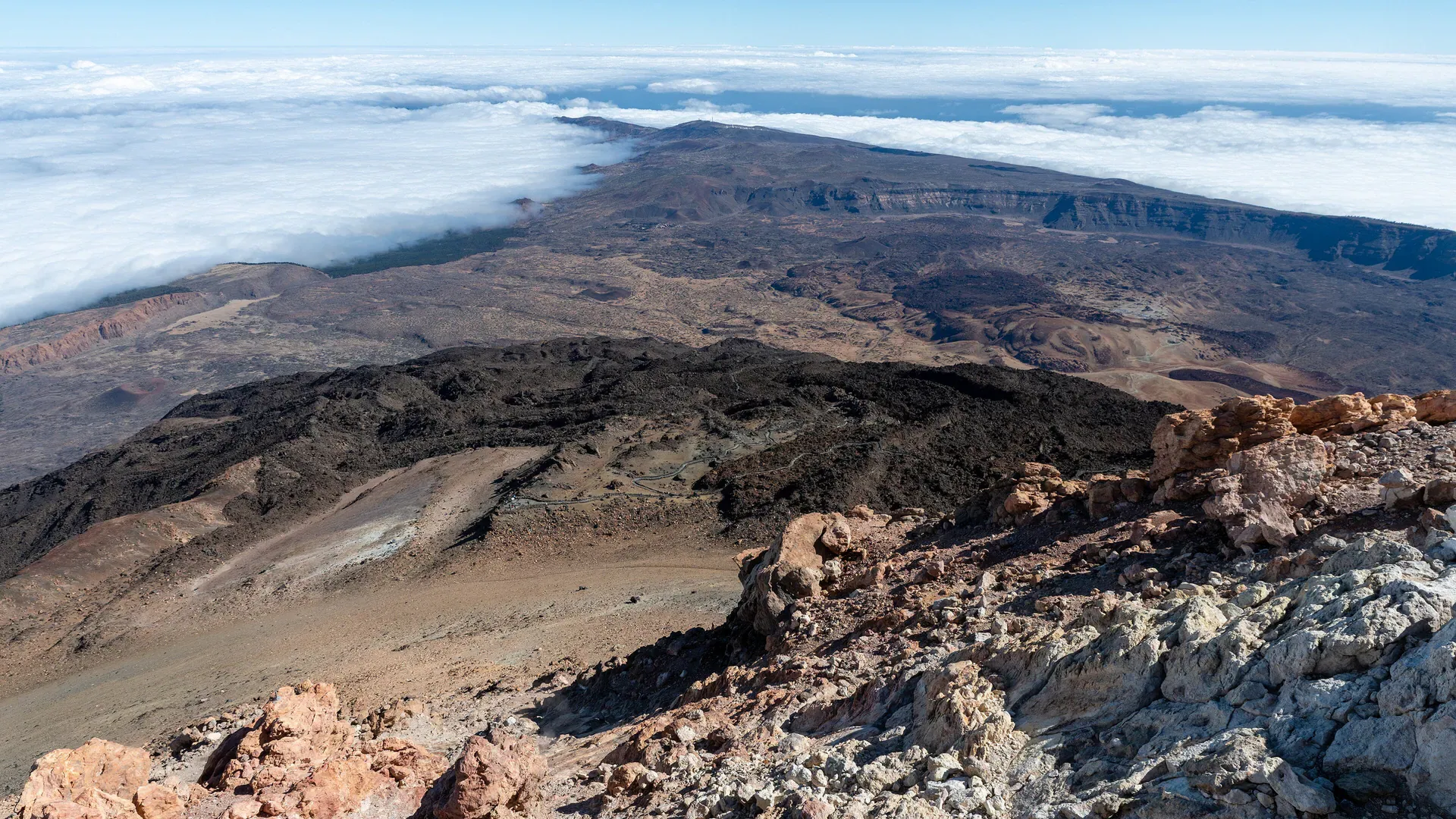
Above the refuge the slope eases across dark lava flows towards the Mirador de La Fortaleza junction and La Rambleta. There you show your PNT 10 permit and ID at the gate and start the last 0.7 km. It looks short on the map, but 183 m of climbing at 3,550 m or higher usually takes 40 to 45 minutes. Fumaroles steam from cracks just below the crater rim.
Walking back down PNT 07 takes another 3 to 4 hours and is hard on the knees. Trekking poles help.
Cable car and La Rambleta
The Teleférico del Teide, run by Volcano Teide, climbs from the base station at 2,356 m to La Rambleta at 3,555 m in about 8 minutes. Cabins start running at 09:00, and the last ascent changes with the season. Wind or ice can stop the lift at short notice, so check the live status on the operator’s site before driving up from the coast. Children under 3 and pregnant visitors cannot ride.
Fares for visitors from outside the Canaries:
| Ticket |
Adult |
Child 3 to 13 |
| Return |
From €42 |
From €21 |
| One way (up or down) |
€24 |
€12 |
Canary residents pay €6 adult and €3 child one way, with a discounted return.
If you have no PNT 10 slot, two trails from La Rambleta need no permit and are open to lift passengers with proper footwear and warm clothing:
- PNT 11 to Mirador de La Fortaleza: 0.6 km, 39 m of ascent, about 25 minutes, with views over the Orotava Valley and the cloud sea on the north side.
- PNT 12 to Mirador de Pico Viejo: 0.7 km, 21 m of ascent, about 30 minutes, looking into the Pico Viejo crater.
Refugio de Altavista
Refugio de Altavista (3,260 m) reopened on 20 July 2026 after a renovation. It had been closed since November 2019. It has 49 beds, the maximum stay is one night, and booking is online only at refugioaltavista.com. Beds start at €29 for Tenerife residents and €71 for other visitors.
One booking includes both permits. The PNT 07 permit covers arrival day from 15:00 to midnight, and the PNT 10 slot is for the next morning, so you can be on the summit for sunrise. Check the confirmation for the exact summit window.
The refuge has toilets but no showers, and a common room with a microwave and vending. Bring your own dinner, breakfast and water, and download your booking before you leave the coast, because mobile data is unreliable at 3,260 m. Sleeping above 3,200 m without acclimatising can mean a restless night and a mild headache.
Altitude and weather
Beach weather says nothing about Teide. When Costa Adeje is at 24°C, La Rambleta and the summit cone are an exposed high mountain.
Altitude sickness (mal de altura) shows up at 3,555 to 3,715 m as headache, dizziness, nausea, heavy legs and breathlessness on easy steps. Cable car riders often feel it more than hikers, because the lift gains 1,199 m in 8 minutes with no gradual adaptation. Spend an hour or two in the Las Cañadas caldera first, perhaps on the Roques de García walk. Drink water steadily, skip alcohol the night before, and walk slowly. If you get a severe headache, vomiting, confusion or poor balance, descend at once. Severe altitude sickness can become pulmonary or cerebral edema, which are emergencies.
By season:
- Spring (April and May) and autumn (September to November) are the most stable, with dry footing and clear mornings. Winter fronts can arrive in late autumn.
- Summer has long days and dry trails, but strong UV and occasional calima (Saharan dust).
- Winter (December to March) brings temperatures from 0°C to well below freezing at the top, snow, black ice and strong wind. Closures are likely.
Check the Izaña and Teide forecasts on AEMET, and the trail notices on Tenerife ON, the evening before and the morning of your hike. When snow or ice is present, Tenerife ON closes trails or restricts them to experienced mountaineers who sign a declaration and carry crampons and an ice axe. Frozen snow on Lomo Tieso or Telesforo Bravo is hard ice, not soft walking snow.
Required gear
Rangers check permits and bags at Montaña Blanca and at the La Rambleta gate. A confirmed booking does not guarantee entry if you lack the required equipment, and they can turn you back.
- Mountain boots or sturdy trekking shoes. Trainers and sandals risk refusal.
- Long trousers and a warm layer, even in summer.
- An emergency thermal blanket, a headlamp or torch with a spare battery, and a charged phone.
- Water. The park requires bottled water, and there is none on the volcano. Carry more for PNT 07 than for the lift route.
- A hat and gloves. Add sunscreen and sunglasses, since UV is strong above 2,000 m and the pale pumice reflects it.
- Original passport or national ID, matching the permit.
- Crampons and an ice axe when snow or ice is present, with a signed declaration.
Bring a power bank too, because cold drains batteries, and an offline map for the stretches without reception.
Getting there without a car
Two TITSA buses climb into the park daily and stop at the Parador, the cable car base, Montaña Blanca and El Portillo. The ten+ and day passes do not cover lines 342 and 348, so pay for the ticket separately and check the current fare on titsa.com.
- Line 342 leaves Costa Adeje about 09:25, via Los Cristianos and Vilaflor, and reaches the cable car at about 11:06. The one afternoon return leaves the park about 15:30.
- Line 348 leaves Puerto de la Cruz about 09:30 via La Orotava, and its return leaves the cable car about 16:05.
Confirm times on titsa.com the night before. Missing the single afternoon bus leaves you at 2,350 m with no other public transport.
You get roughly 4.5 to 5 hours in the park, which fits a cable car visit with PNT 10 or the free PNT 11 and 12 trails. Book a lift between 11:30 and 12:30 with a matching early-afternoon PNT 10 slot. An overnight at Altavista also works: take the bus to Montaña Blanca, walk up in the afternoon, summit at sunrise, and catch the afternoon bus back.
A one-day Montaña Blanca climb cannot be done on these buses. Five to six hours uphill alone rules out the afternoon departure, so rent a car for it.